Heart attack, stroke and Alzheimer’s aren’t enough to keep these two octogenarians down. John Dremsa, 80 and Harold Schara, 85, not only still play golf, but they are setting records, too.
John had a brainstorm and soon conned his buddy Harold into going along. They agreed to speed golf and managed to complete 13 holes at Pioneer Pointe in Madison in just one hour and 20 minutes! That’s quite a feat, especially for Harold.
“I got a little arthritis on my left knee. I can’t run that fast anymore,” he explains. He’s also suffered both a heart attack and a stroke less than two years ago.
But they golfed their hearts out, anyway.
“It was so exhilarating,” says John, who was recently diagnosed with Alzheimer’s disease. “Just get up and hit as fast as you can and run back.” Maybe that last comment refers to more than just speed golf.
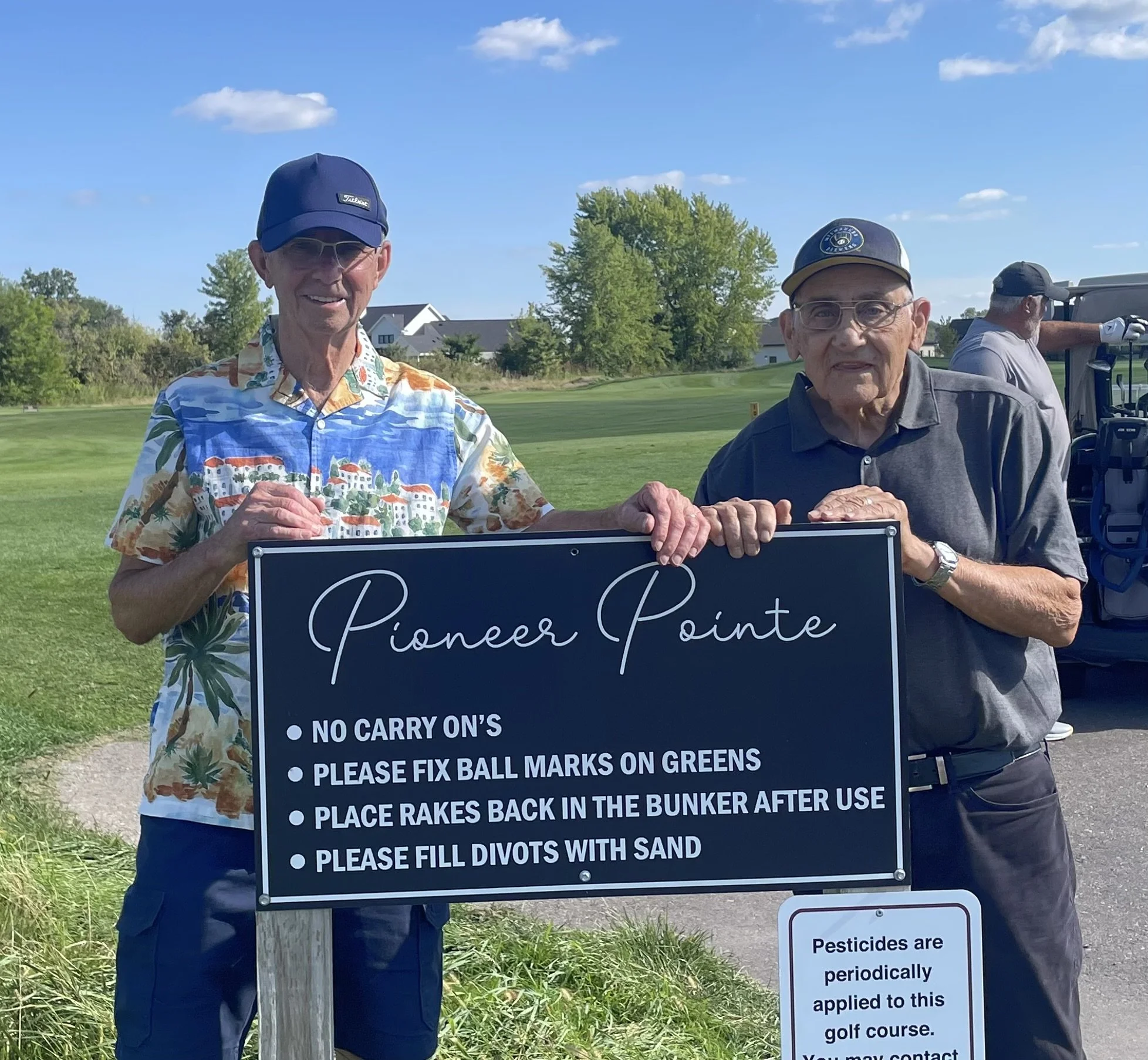
Normally, these two take their time, with Harold lingering in the rough to search for lost balls.
“And I've got, I think, well over 200 golf balls at home, so I don't need anymore. But it's more like an Easter egg hunt, you know? Yeah, and anytime I'm near water or tall grass or something, you go in and look for golf balls.”
These two have claimed the record for the course’s longest golf round, too. On the same course, they once completed a round in five hours because hardly anyone else was on the course that day.
Harold and John, both raised on farms, met each other at church. Their stage in life and health challenges obviously created a special bond between them.
After his heart scare, Harold says it was a wakeup call. “We are not immortal.” There was a time in his life when he apparently thought otherwise. Harold claims to have jumped out of an airplane 1,097 times!
“Just sport jumping,” he says. He’s even parachuted into his own wedding reception!
“So, you’re not afraid of heights, huh?”
“Not at all,” he responds. “Well, not if I have a parachute.”
John’s a bit more down to earth. A retired insurance agent, he’s a big walker who tracks his miles. He figures he’s traversed the equivalent of the entire earth in his life. But golf has been his passion for decades, and he still smacks impressive, straight drives. One of his buddies refers to him as “long-ball Dremsa.”
Despite his diagnosis, John seems to be doing pretty well. He drives, can hold a good conversation and is steady enough to golf. But he’s noticed changes in himself in just the last month, linking his altered mental state to the Alzheimer’s.
“I've gotten kind of crazy. And I say things that are funny to me, and my wife usually kind of grins or something,” he explains. “But sometimes I embarrass her when I say something funny. So, for some reason, my head figured out that I can have a good time, and I probably don't have forever to live.”
Always a gregarious guy, John is especially so now.
“Mainly, I feel the best when I’m helping somebody,” he says. During a recent round of golf, John enthusiastically clapped and or yelled “Attaboy” after every person hit, whether the shot was good, bad or ugly. It’s his way of being supportive.
“I’m so happy. I don’t know what it is,” he gushes. “I think that's why I did the speed thing. I'm happy. It was a challenge. I knew [Harold] would like it. It would help his game and my game.”
It seems as though John has no choice other than to be optimistic.
“I got to be happy because I might not have much time.” He looks to Harold and says, “We don't have a lot of time, do we?”
“Probably not, but I hope a few more,” Harold replies.
“Well, my goal used to be 93, because that's when my dad died.”
It’s only recently that Harold started to golf again, Incredibly, he hadn’t golfed for what he estimates to be 40 or 50 years!
“He got me interested,” Harold says of his buddy, John.
There won’t be any more speed golfing, though, in the time that they have left on the course. That was a one-time challenge, John says.
Instead, John and Harold hope to deepen their friendships, spend time with their families and continue having fun doing it.
Attaboy!
Take that, Alzheimer’s and heart disease.